
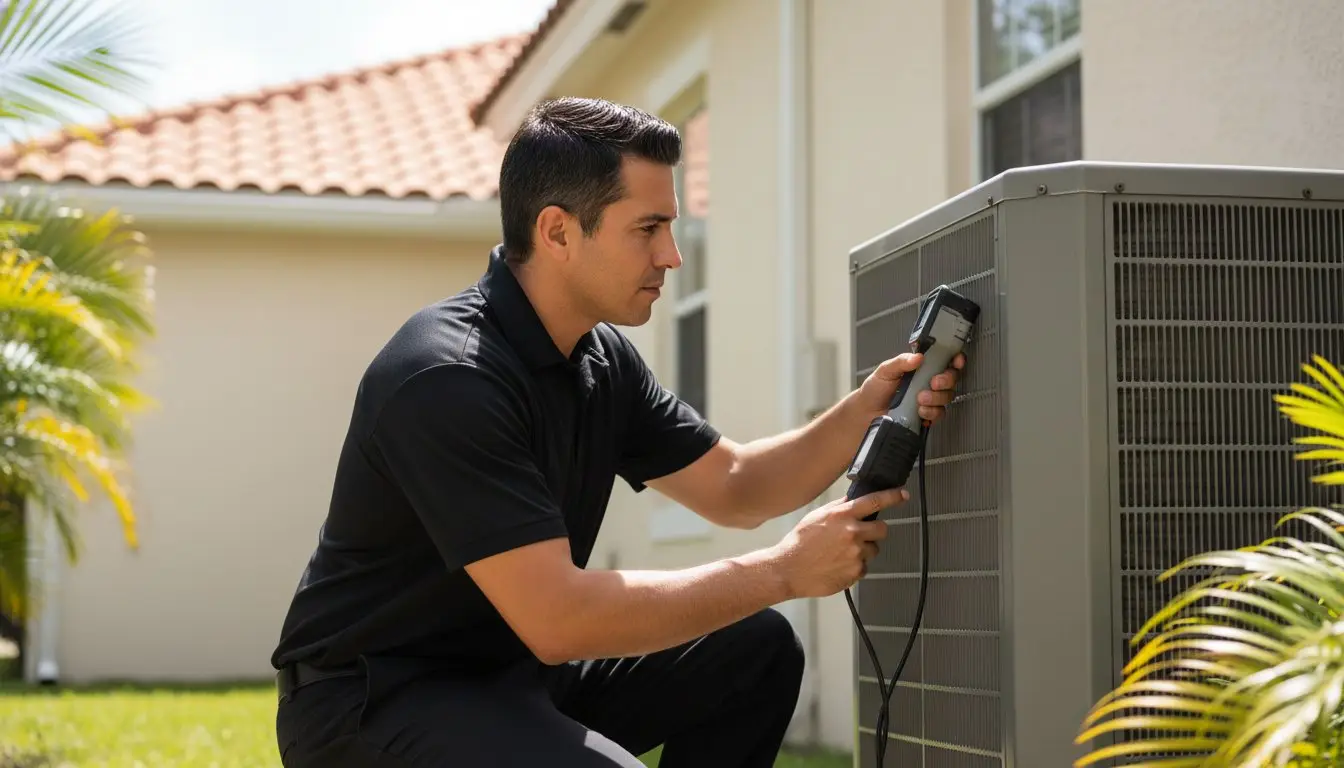
Paying for a quick refrigerant “top-off” might seem like the fastest way to escape the Treasure Coast heat, but it’s often the most expensive mistake a homeowner can make. You’re likely here because your AC is blowing lukewarm air and the Florida humidity is already creeping into your living room. It’s stressful to face an uncertain AC refrigerant leak repair cost in Port St. Lucie, especially when you’re worried about being sold a temporary fix for a permanent problem. We understand that you just want your home back to a comfortable temperature without any hidden surprises or “freon” scams.
This guide provides a transparent breakdown of how local technicians identify leaks and what factors truly influence your final bill. You’ll learn how the 2026 EPA phase-downs are impacting the availability of older refrigerants like R-410A and why some systems are no longer viable to fix. We’ll walk through modern leak detection methods and give you the tools to decide if a repair or a full system replacement is the smartest move for your Port St. Lucie home.
Key Takeaways
- Learn why the specific type of refrigerant in your unit, such as R-410A or R-32, is the primary driver of repair expenses in 2026.
- Understand why a refrigerant “top-off” is only a temporary band-aid and how professional leak detection identifies the actual source of the problem.
- Discover how the location of a leak, whether in the indoor evaporator coil or outdoor condenser, impacts the complexity and time needed for a fix.
- Use the “$500 Rule” to evaluate your AC refrigerant leak repair cost in Port St. Lucie against the long-term value of a newer, more efficient system.
- Get expert advice on how the intense Florida humidity affects your system’s lifespan and when it’s time to stop repairing a unit that’s past its prime.
Factors Influencing AC Refrigerant Leak Repair Costs in Port St. Lucie
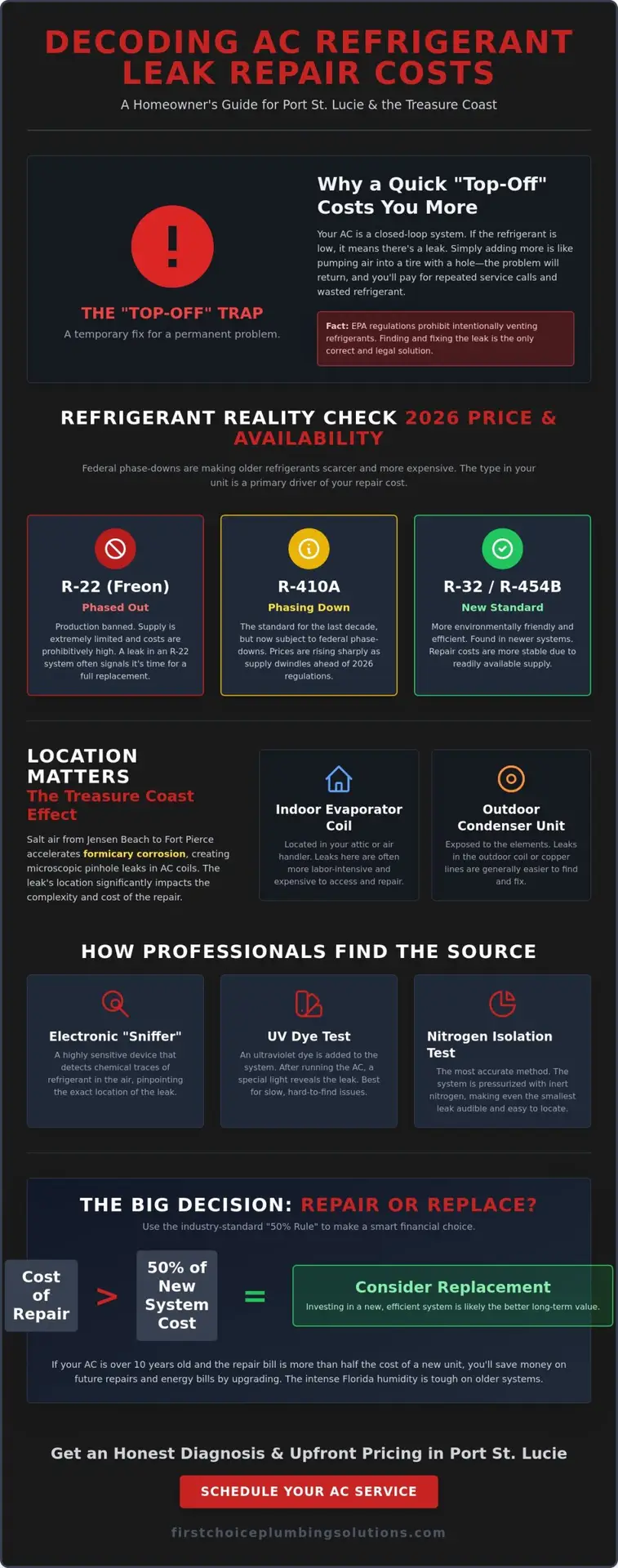
When your air conditioner stops cooling, the final bill depends on more than just a quick fix. Several variables dictate your total AC refrigerant leak repair cost in Port St. Lucie. The primary driver is the chemical refrigerant itself. If you own an older system using R-22, you’re facing a “Legacy Tax” because this gas was phased out years ago. Even R-410A, the standard for the last decade, is seeing significant price hikes due to federal phase-downs under the AIM Act. These regulatory shifts mean that the age of your unit is often the biggest factor in your repair budget.
Refrigerant Types and 2026 Price Trends
The 2026 market reflects a massive shift in supply and demand. R-410A is becoming scarcer as manufacturers transition to newer, more environmentally friendly options like R-32. This scarcity directly impacts what you pay for a recharge after a technician patches a leak. First Choice Plus provides transparent, upfront pricing before any refrigerant is added, so you know exactly where you stand before the work begins. Understanding these trends helps you decide if a simple repair is a wise investment or a lost cause.
Why Location Matters: Salt Air and Coil Corrosion
Living on the Treasure Coast presents unique challenges for HVAC systems. Homes from Jensen Beach to Fort Pierce deal with high salt content in the air. This salt accelerates formicary corrosion, a process that creates microscopic pinhole leaks in copper coils. Finding a leak in an indoor evaporator coil is often more labor-intensive and expensive than finding one in an outdoor condenser. Patching a single copper line is a straightforward task. However, if salt air has compromised an entire aluminum coil, a full component replacement is usually the only reliable solution. Local labor rates for skilled technicians also reflect the complexity of these deep-system repairs in our humid climate.
The Professional Leak Detection Process: Why a ‘Top-Off’ Isn’t a Fix
Your air conditioner operates as a closed-loop system. This means the refrigerant stays inside the copper lines indefinitely unless there’s a physical breach. If a technician tells you that you’re “just a little low,” it means you have a hole that needs fixing. Choosing to top off the system without a repair leads to “ghost leaks” that disappear and reappear, causing repeated service calls and mounting expenses. Beyond the financial hit, EPA Section 608 regulations prohibit the intentional venting of refrigerants because of their environmental impact. Finding the source of the leak is the only way to manage your AC refrigerant leak repair cost in Port St. Lucie effectively.
Diagnostic Methods: Electronic Sniffers vs. Dye Tests
Technicians use several specialized tools to find microscopic cracks. Electronic leak detectors, or “sniffers,” sense chemical traces in the air to pinpoint the exact location of a leak. While ultraviolet (UV) dye is sometimes used for slow, stubborn leaks, it’s often a secondary choice because it requires the system to run for days before a result is visible. For the most accurate results, we often recommend nitrogen isolation tests. This process involves draining the system and pressurizing it with dry nitrogen to listen for the hiss of escaping gas. Industry data on AC leak repair costs confirms that while these diagnostics take time, they prevent the need for guessing.
Common Leak Points in Treasure Coast HVAC Systems
Many leaks occur at the Schrader valve, a small component similar to the valve on a bicycle tire. It’s a ten dollar part, but a failure here can lead to hundreds of dollars in lost gas. We also frequently see vibration-induced leaks near the compressor housing, where constant movement eventually fatigues the metal. If you suspect your system is struggling, scheduling an emergency AC repair in Port St. Lucie can stop a small leak from turning into a total system failure. You can also explore our guide on AC repair Port St. Lucie to understand how these leaks fit into broader maintenance needs. Taking action early ensures your home stays cool without draining your wallet on temporary refills.
The $500 Rule: Should You Repair the Leak or Replace the AC?
Deciding whether to pay the AC refrigerant leak repair cost in Port St. Lucie or invest in a new unit comes down to simple math. We recommend using the “50% Rule” as your primary guide. If the estimated repair bill exceeds half the current value of your air conditioner, a replacement is usually the smarter financial move. This is especially relevant for units reaching the 10-year mark. In our Treasure Coast climate, the combination of high humidity and salt air often causes systems to face a “mid-life crisis” where multiple components begin to fail simultaneously.
Upgrading to a modern system also brings the benefit of 2026 SEER2 efficiency standards. These units use significantly less energy to cool your home, which helps lower your monthly FPL bills. Federal law and EPA leak repair requirements mandate that leaks in larger systems be properly addressed rather than just topped off. Investing in a new system ensures you are compliant with environmental regulations while enjoying a more reliable, cooler home.
When Repair Makes Most Sense
- Warranty Status: If your unit is under a 5 or 10-year manufacturer parts warranty, repairing the leak is almost always the best choice.
- Simple Access: Leaks located in accessible copper joints or at the service valves are relatively straightforward and cost-effective to fix.
- Maintenance History: Systems that have received consistent annual tune-ups generally have a longer remaining lifespan, making a repair a safer bet.
When to Call It Quits and Upgrade
If your technician finds the “Swiss cheese” effect, which is multiple tiny leaks throughout the evaporator coil, a repair is only a temporary fix. Units still running on R-22 refrigerant are also prime candidates for replacement because the gas is obsolete and parts are difficult to source. In these situations, we recommend exploring a professional AC installation service near me to restore your comfort permanently.
Our Port St. Lucie team is ready to help you weigh these options with an honest assessment of your system’s health. Please keep in mind that while our main location provides full AC and plumbing services for the Treasure Coast, our Land O’ Lakes office specializes exclusively in plumbing and does not perform air conditioning work.
Take Control of Your Home Comfort Today
Managing your AC refrigerant leak repair cost in Port St. Lucie doesn’t have to be a guessing game. By understanding how the current 2026 refrigerant market affects your specific system and applying the $500 rule, you can make a choice that protects both your comfort and your budget. A professional leak detection is the only way to stop the cycle of expensive refills and prevent potential environmental damage to our beautiful Treasure Coast.
Our team provides 24/7 emergency AC service throughout Port St. Lucie and Stuart. We employ expert technicians trained in EPA-certified refrigerant handling to ensure every job is done safely and correctly. We believe in honest, upfront pricing with no hidden surcharges, so you always know what to expect before we begin work. Stop wasting money on refills; schedule your professional leak detection in Port St. Lucie today! We’re here to help you keep your home cool and your HVAC system running efficiently.
Common Questions About Refrigerant Leaks
How much does a typical AC refrigerant recharge cost in Port St. Lucie?
A typical recharge depends on the type and volume of gas your specific system requires. While labor rates across the Treasure Coast remain fairly steady, the market price for R-410A has increased significantly in 2026 due to federal supply limits. Costs fluctuate based on whether you have a small residential unit or a large multi-ton system. We always provide a clear explanation of these market factors before beginning any work on your cooling system.
Is it legal for an HVAC technician to just refill my AC without fixing the leak?
It is generally legal for residential systems, but it is a poor long-term strategy for your wallet. EPA regulations under Section 608 prioritize the containment of refrigerants to protect the environment. Most reputable technicians in Port St. Lucie will recommend a permanent repair rather than a “top-off.” Repeatedly refilling a leaking unit is a waste of money because the gas will inevitably escape again, often through a larger hole.
What are the signs that my AC has a refrigerant leak?
Common signs include lukewarm air coming from your vents and longer cooling cycles that never seem to satisfy your thermostat. You might also notice a hissing sound near the indoor air handler or ice forming on the copper lines. These symptoms indicate a drop in system pressure. Your total AC refrigerant leak repair cost in Port St. Lucie will depend on how quickly the issue is isolated. Early detection prevents total compressor failure.
How long does a refrigerant leak repair typically take?
Most leak repairs take between three and five hours to complete from start to finish. This timeframe includes the diagnostic phase to find the breach, the physical repair or part replacement, and the vacuum process to remove moisture. If the leak is located in a difficult area, such as a buried line set or within a cramped attic in St. Lucie West, the process can take longer. We work efficiently to restore your comfort as quickly as possible.
Will homeowners insurance cover the cost of an AC refrigerant leak repair?
Homeowners insurance rarely covers leaks caused by normal wear and tear or salt air corrosion. Coverage is typically reserved for sudden accidents, like a storm damaging your outdoor unit. Check your specific policy for details on equipment breakdown coverage. The standard AC refrigerant leak repair cost in Port St. Lucie is usually viewed as a maintenance item. Regular tune-ups are the best way to avoid these unexpected out of pocket expenses.
Can I fix an AC refrigerant leak myself using a ‘stop leak’ kit?
You should never use a DIY “stop leak” kit in a residential HVAC system. These products are often designed for automotive use and can cause catastrophic damage to a home’s compressor and sensitive internal valves. Handling refrigerants requires specialized tools and EPA certification to ensure safety. Attempting a DIY fix will likely void your manufacturer warranty and lead to a much more expensive system replacement down the road.

Article by
Written by First Choice Plus Plumbing & Air Team
This article was created by the team at First Choice Plumbing Solutions, a licensed and experienced plumbing and HVAC company serving Port St. Lucie, Land O’ Lakes, and surrounding areas.
Our team specializes in plumbing and air conditioning services, including drain cleaning, leak detection, water heater repair and installation, AC repair, maintenance, and system installations. Our content is based on real-world experience and the common issues we solve for homeowners and businesses every day.
We aim to provide accurate, helpful, and easy-to-understand information so you can make informed decisions about your plumbing and HVAC needs.
If you need reliable, professional service, First Choice Plumbing Solutions is here to help.
Disclaimer
Disclaimer: The information provided in this article is for general informational purposes only and does not constitute professional plumbing or HVAC advice. Every situation is different, and readers should consult a licensed professional for proper diagnosis and repair. First Choice Plus Plumbing & Air is not liable for any damages or losses resulting from the use of this information.